I spent three hours one Saturday afternoon copying form submissions into Word documents.
A client needed professional invoices for every quote request. So, I copied data from 27 form entries, formatted each one, saved as a PDF, and emailed them individually.
My back hurt from sitting, my eyes burned from staring at spreadsheets, and I kept making mistakes copying customer names and addresses.
The worst part? I knew there had to be a better way. Free online PDF converters felt sketchy with client data. Plus, in the end, the PDFs looked generic and unprofessional.
Turns out, WordPress form plugins can generate branded PDFs automatically, which is way better than the generic results I got from online PDF tools. No copying, no formatting, no manual emails.
Just professional documents delivered instantly.
After I discovered this, I tested all the best WordPress forms plugins that I could find to see which actually made PDF creation easy. In the end, I identified WPForms and Formidable Forms as the best options.
In this guide, I will walk you through how to convert your form submissions to PDF with these two form plugins.
To see all the steps at a glance, use the table of contents below. plus you can also use it to skip to any section of this tutorial.
- Why Convert Form Submissions to PDF?
- Method 1: Convert Form Submissions to PDF with WPForms
- Method 2: Formidable Forms Print to PDF (Quick Alternative)
- WPForms vs Formidable Forms for PDFs: Quick Comparison
- FAQs: Converting Form Submissions to PDF
- Final Thoughts: Professional WordPress Form PDFs Made Simple
- Related Resources
With that out of the way, let’s dive in.
Why Convert Form Submissions to PDF?
Professional documentation matters more than most people realize.
I have lost count of the number of times a client has been rejected because their quote form submission “wasn’t official enough.” A simple PDF with their logo would’ve solved it.
Here are other reasons you should convert your form submissions to PDF in WordPress.
- PDFs create legal documentation: Courts accept them, insurance companies trust them, and accountants love them. Your inbox email screenshot? Not so much.
- Security becomes automatic: Free online PDF converters send your customer data to random servers. Who knows what happens to that information? When WordPress generates PDFs directly, the data never leaves your server.
- Professional appearance builds trust: A branded PDF with your logo and colors screams legitimacy. Branded PDFs look like real business documents. While Generic form emails look like spam.
- Record-keeping gets easier: Every submission becomes a searchable file. No more digging through email threads trying to find what someone ordered three months ago.
- Customers expect it now: When someone requests a quote or makes a purchase, they want a professional PDF receipt. Not a plain-text email.
Plus, you can use this feature for more than just invoices. You can also create customer feedback forms that collect reviews and testimonials in PDF format for added professionalism.
Or for job applications, surveys, internal forms, and so on.
Now that you understand why converting your form submissions is so important, let me show you how to do this step by step.
Method 1: Convert Form Submissions to PDF with WPForms
WPForms is the best drag-and-drop form builder. It solved my PDF problem in under 15 minutes.
This is possible because the WPForms PDF Addon gives you 40+ professional templates.
All you have to do is pick one, add your logo, add customization, and every form submission automatically generates a branded PDF. No manual work after setup.
Apart from the drag-and-drop builder, you can now create a WordPress form using AI to speed up the initial form-building process.
I tested invoice templates, certificate layouts, and legal document formats. All looked professional enough to send to paying customers.
I especially like the live preview, which shows exactly what the PDF would look like before I save anything.
Here’s the catch: you need WPForms Pro or higher. WPForms Lite, the free version, doesn’t include PDF functionality.
But if you’re serious about professional documentation, the upgrade pays for itself in time saved.
Check out my updated WPForms review to see all the features this forms plugin comes with
Step 1: Install WPForms & Activate the PDF Addon
It is super simple to install WPForms. To access the Pro version you must visit their official website and make a purchase. As mentioned, to access PDF features, you need a Pro Plan or higher.
Once you purchase the plugin, log in to your WPForms account and download the file. Also, copy the License Key.
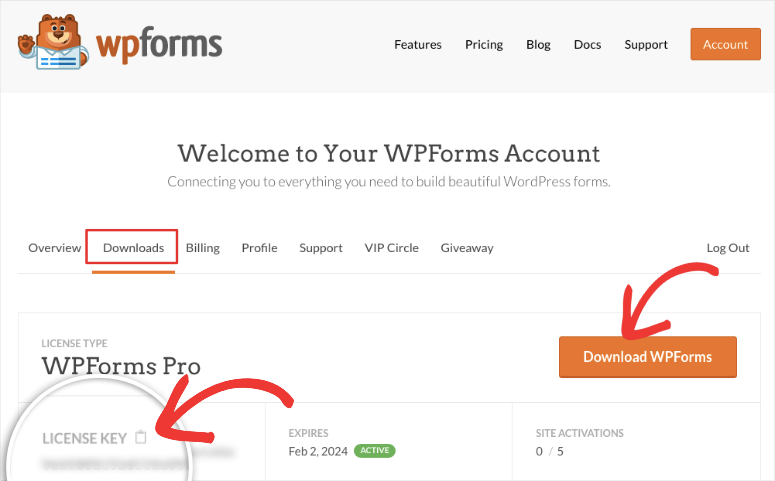
Then, head over to your WordPress dashboard and install it. I will not walk you through the setup process step by step; check out this post if you want to learn how to install WPForms.
After installing and activating, you should see a new menu option on your WordPress dashboard called “WPForms.” To keep the plugin light, WPForms only has the base features after installation.
To access more features, you need an addon.
Now, let me show you how to set up the PDF addon.
Next, navigate to WPForms » Addons in your left sidebar.
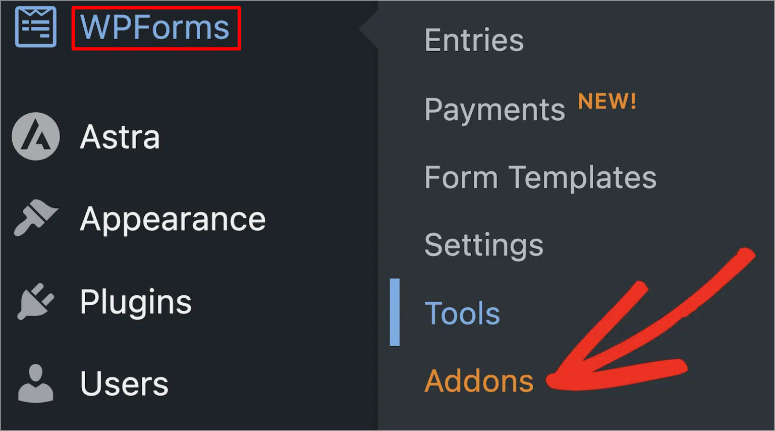
Here, you’ll see a list of available addons. Then, search for “PDF” in the search box at the top. Once you see it, select Install Addon, then “Activate” it.
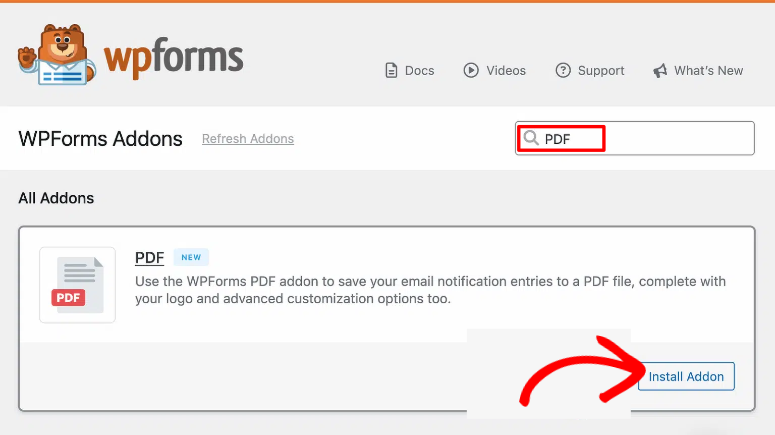
After this, there is no extra configuration needed at this stage. You’ll see a green checkmark confirming it’s active.
Step 2: Create or Edit Your Form
Before diving into PDF settings, you need a form with the right fields for your document. Remember, everything starts with building a form.
The fields you include in your form become the data that populates your PDF. Skip a field here, and you’ll have blank spaces in your document later.
⚠️Note: If you are already building forms with WPForms, you can edit the existing ones. In your case, skip to Step 3.
Now, to create a new form, go to WPForms » Add New in your WordPress dashboard. On this screen, you will see the +2000 WPForms templates to choose from.
Choose a Template:
As mentioned, WPForms gives you pre-built templates that match common document needs.
For invoices or quotes, start with the Order Form template since it includes product selection, quantities, and pricing fields already configured.
For certificates or awards, the Event Registration template works great as a foundation.
Want to speed things up? Hover over Generate With AI and click the Generate Form button. Describe what you need, and WPForms builds the form structure for you in seconds.
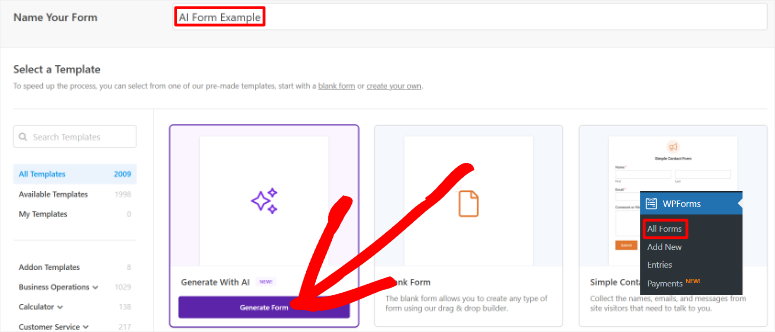
Check out this guide to learn how to build your forms with AI.
As if that’s not enough, you can also select Blank Form if you prefer starting from scratch.
But for this tutorial, I went with the Simple Contact Form template to make it super simple for you to understand.
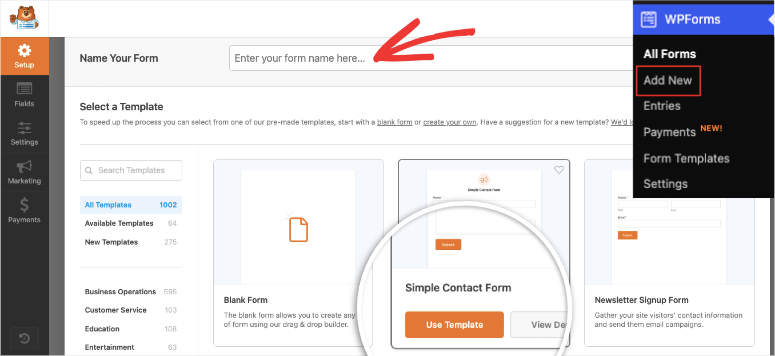
Once you select your template, you will be redirected to the drag and drop form builder so that you can customize your form for your business.
The fields are on the right, and the preview section is on the left. Simply drag the fields on the left to the previous on the right to the exact location you want the field to appear, and you are all set.
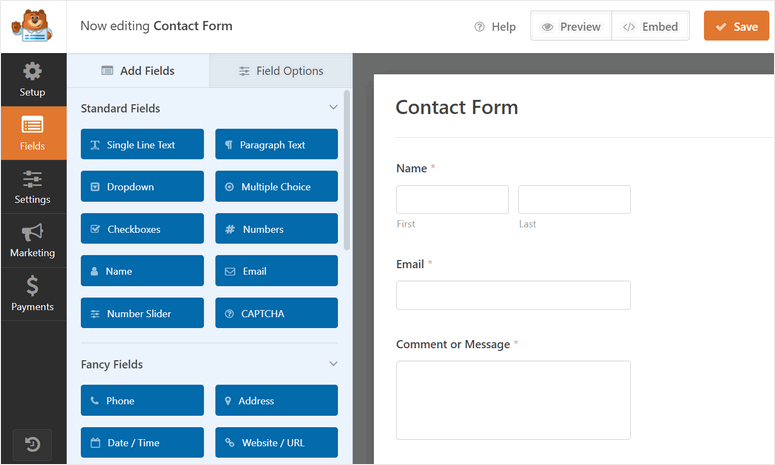
Add the Right Fields:
Once you have customized your form, you need to make sure that you have the right fields for the PDFs you want to create.
For example, every invoice needs customer information. So, add Name and Email fields first. Need product or service selection? Add Dropdown or Checkbox fields listing your offerings.
For quantities or amounts, include Number fields. These calculate totals automatically when you set up payment processing.
Check out this article for a detailed explanation on how to customize your forms with WPForms.
Step 3: Set Up Your PDF Configuration
With your form ready, it’s time to tell WPForms how to generate the PDF.
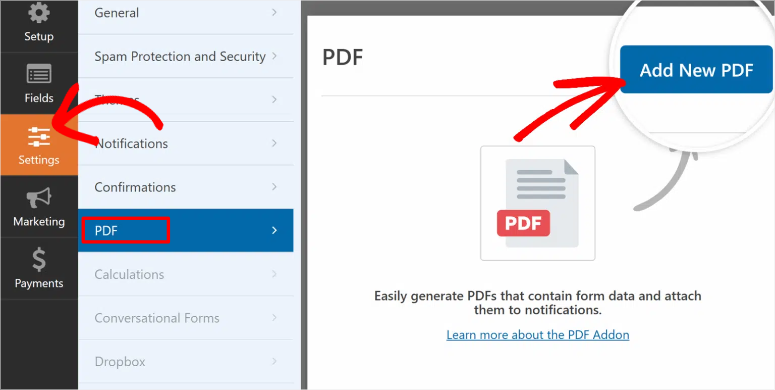
Open your form in the WPForms builder and select the Settings tab in the left sidebar. Then, on the menu options you see next, select the PDF tab.
Once the PDF settings page opens, you should see it’s empty. Click the Add New PDF button to get started.
Next, a small popup asks you to name your PDF. This name is just for your dashboard organization, not the actual PDF filename.
Use something descriptive like “Client Invoice PDF” or “Course Certificate” so you remember what it does six months from now.
Once done, click OK.
Welcome to the PDF Editor:
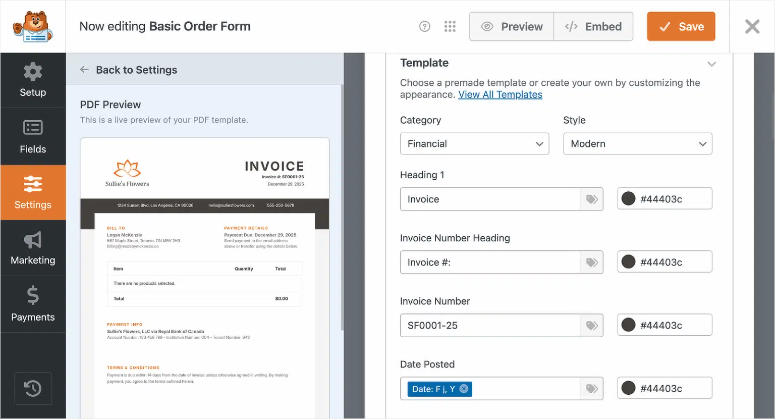
First, you will notice that the interface splits into two sections. The left side shows a live preview of your PDF, while the right side contains all your customization options.
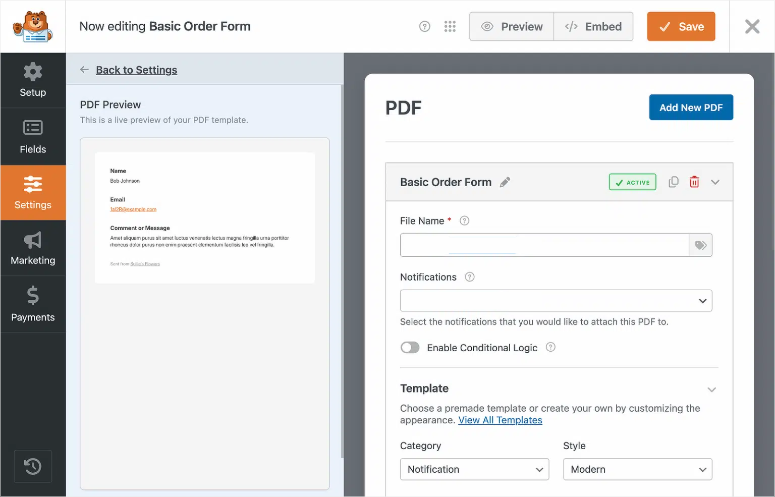
Like with the drag-and-drop builder you used earlier, what you see in the preview is exactly what your customers receive. No surprises, no guessing.
Configure the File Name:
The File Name field determines what the downloaded PDF is called.
The default generic name won’t help anyone. So, use smart tags to create unique, organized filenames.
Type {form_name}-{entry_id}.pdf in the file name field.
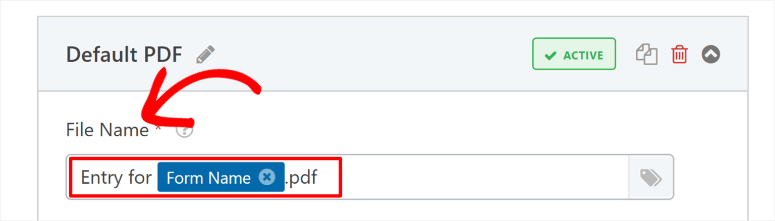
This creates filenames like “Quote-Request-127.pdf” or “Registration-456.pdf”.
The entry ID makes every file unique. No more downloading “form.pdf” 50 times and watching your computer rename them “form (1).pdf” through “form (50).pdf”.
Check out this tutorial to fully understand WPForms Dynamic Tags and how to use them.
Set Up Email Notifications:
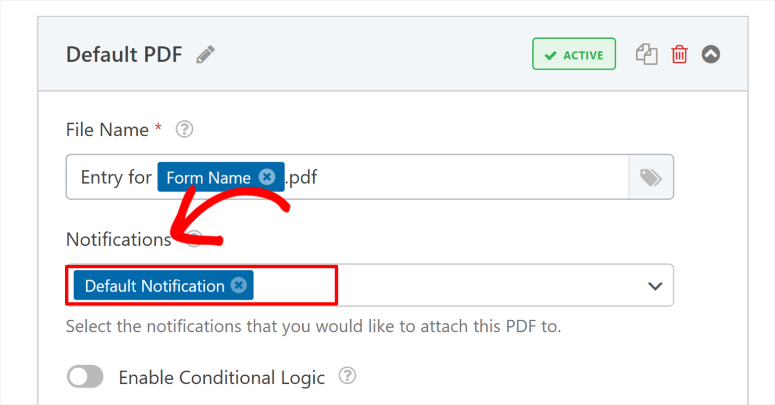
Scroll down to the Email Notifications dropdown to control which email notifications get the PDF attached automatically.
Your options:
- Default Notification: sends the PDF to you (the admin). You get a copy for your records.
- User Notification: sends the PDF to whoever filled out the form. They get instant confirmation.
- Both: sends to everyone. This is what I recommend for most situations.
Remember, the customer wants proof of their submission, while you want it filed in your records. As a result, both of you should get the PDF automatically.
To allow you to send a copy to yourself and the user, select the “Default Notification” Smart Tag.
(Optional) Conditional Logic:
See the Conditional Logic section? This lets you generate PDFs only when specific conditions are met.
Example: Only create invoices when the order total exceeds $50. Or only generate certificates when someone selects “Course Completed” from a dropdown.
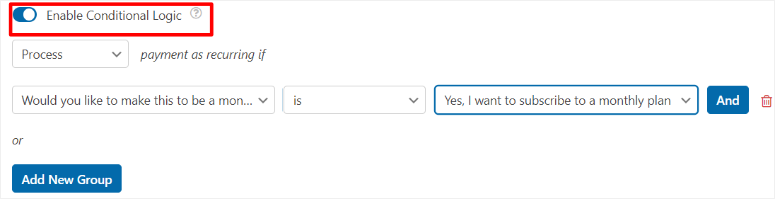
Most people skip this initially. But the good news is that you can always add conditional logic later if you need it.
Step 4: Choose Your Template and Style
This is where your PDF transforms from generic form data into a professional, branded document.
As mentioned, WPForms includes 40+ pre-designed templates organized into four categories. Each one solves a specific document need.
To select a template, check the All Templates button at the top of your PDF editor. Then you will see all the templates displayed.

The Four Template Categories:
- Notifications: templates match email styles for simple summaries. Think order confirmations or contact form receipts. Clean, compact, easy to scan.
- Documents: templates offer flexible layouts perfect for contracts, applications, and official paperwork. Professional formatting with clear section headers.
- Financial: templates are built specifically for invoices, quotes, and billing statements. They include line items, totals, and payment terms already structured.
- Certificates: templates provide award and completion layouts. Landscape orientation, decorative elements, space for signatures.
I’m creating an invoice, so I selected Financial. Check out a sample of how it looks below.
Customize Your Content:
Now the fun part. You can edit almost everything in the template.
See that preview on the left? It’s clickable.
Click any text field in the preview and a red outline appears showing what you’re editing, and a text editor pops up on the right.
Now, replace the placeholder text with your actual business information.
The text editor includes formatting options. With this feature, you can add headings, make text bold, create bullet points, and insert links. If you know HTML, you can add custom code too.
Smart Tags Pull Dynamic Data:
This feature saves massive time.
Instead of typing static text, insert smart tags that automatically pull information from form submissions.
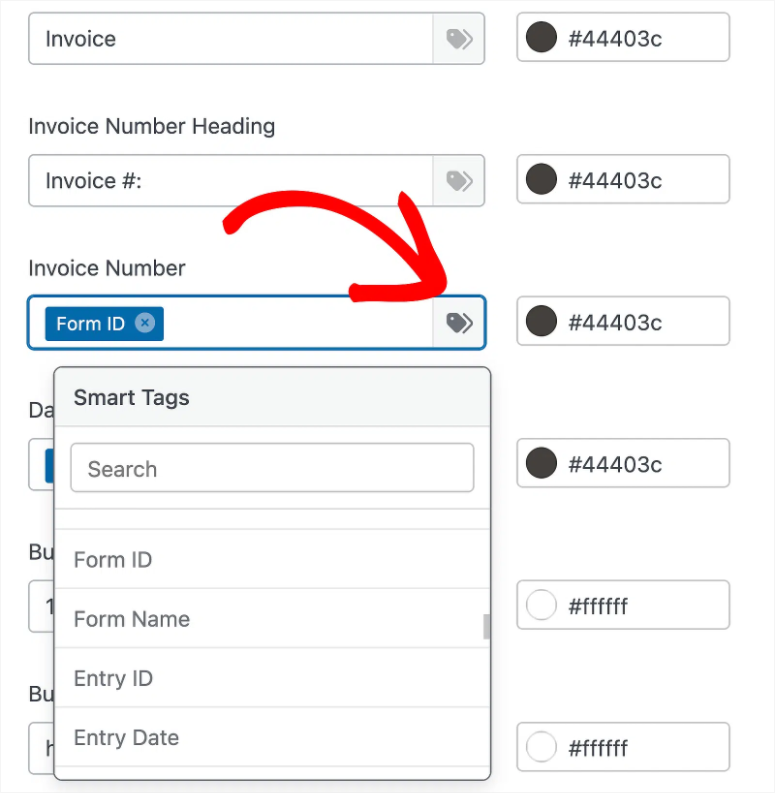
To do this, click the Smart Tag icon next to any editable field. After this, a dropdown appears listing all your form fields plus system data.
Here’s what I use most:
- {entry_id} creates unique invoice numbers automatically. Entry 1 becomes Invoice 1, entry 2 becomes Invoice 2, and so on.
- {field_id=”X”} pulls data from specific form fields. Replace X with your field number. If field 3 is “Customer Name”, use {field_id=”3″} to insert it.
- {date format=”F j, Y”} adds the submission date formatted as “January 12, 2026”.
- {form_name} shows which form was submitted.
Brand Your PDF Appearance:
Once you adjust the colors, scroll down to the Appearance section. This is where real branding happens.
First, choose your color theme. The color theme dropdown shows pre-made color schemes. Each theme name shows color previews.
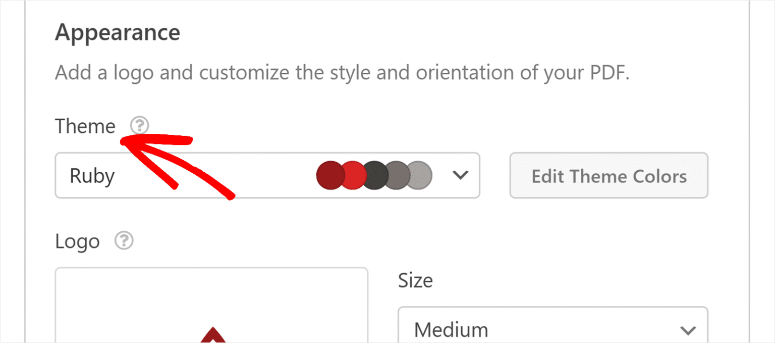
Don’t like any pre-made themes? Click Edit Theme Colors and edit them to your desire.
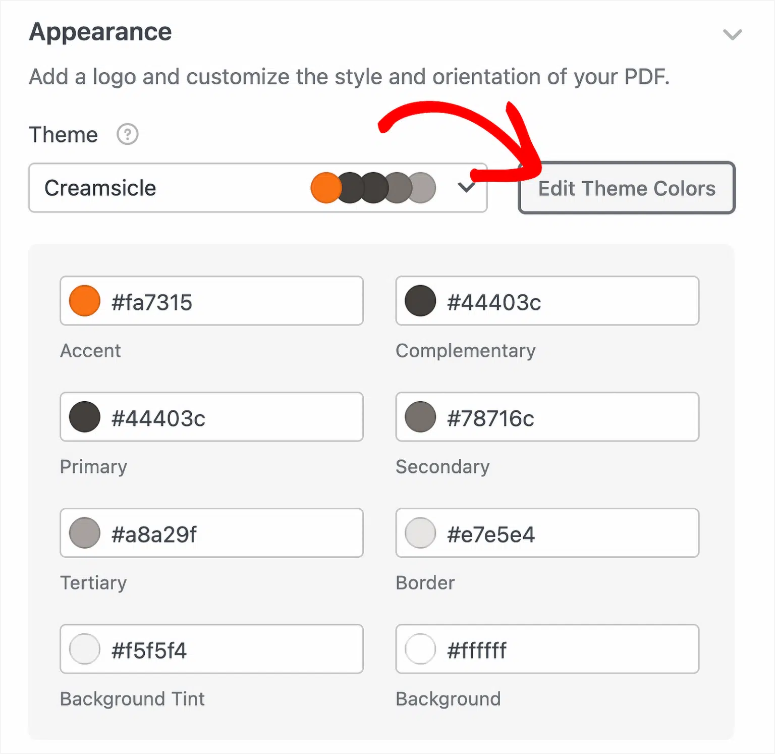
Now, for design safety, WPForms creates a copy of the theme instead of overwriting the original. As a result, you can experiment freely and always revert back.
Upload Your Logo:
Next, select the Upload Image button in the Appearance section. After this, select your logo file. WPForms accepts .png, .gif, .jpg, and .svg formats.
After uploading, you’ll see size and position options that allow you to adjust your logo.

Once happy, click Save before moving on. You’ve built a professional, branded PDF template, and it is now ready to go live.
Step 5: Test and Launch Your PDF System
Before you make your PDF submission form live, I always recommend that you never skip testing. So, once you Save the form using the button at the top of the form builder, this locks in all your PDF settings.
Now You Can Submit a Test Entry:
Use the Preview button near the top of your screen and click it. Your form opens in a new browser tab, looking exactly how visitors will see it.
Fill out the form with test data. Don’t just type “test” in every field. Use realistic information.
After this, submit your test form.
Find Your Generated PDF:
Next, navigate to WPForms » Entries in your WordPress dashboard. Here, you’ll see your test submission at the top of the list. Click View next to it.
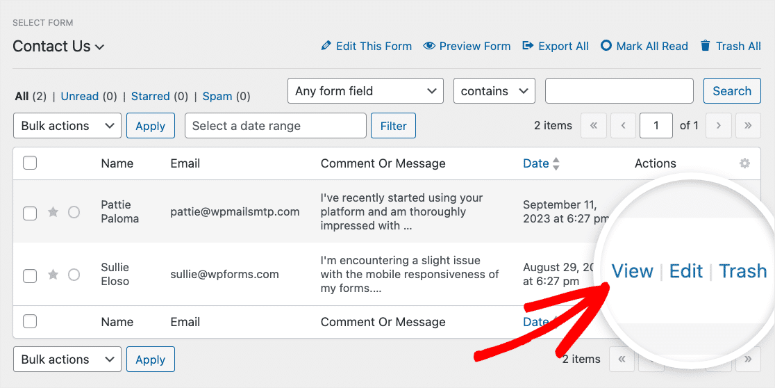
Next, the entry details page opens, showing all the form data submitted.
Look for the PDF section below the entry information, and hit the download link with your PDF filename.
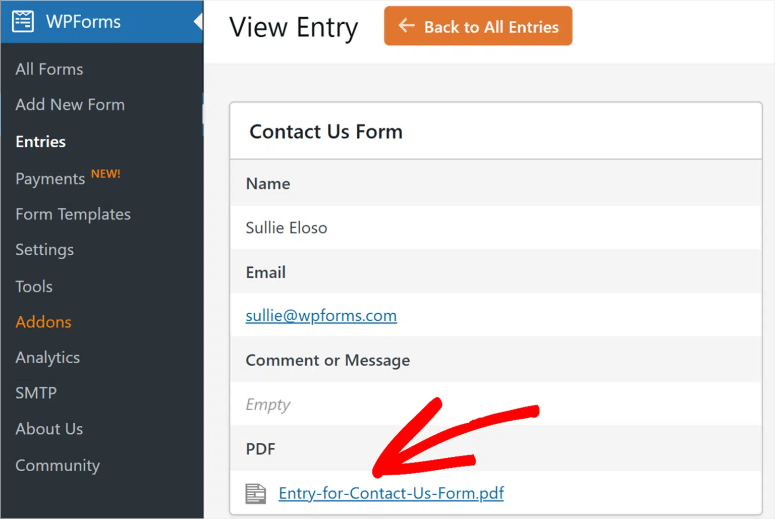
Open the File and Quality Check Your PDF, and make sure that everything works correctly.
Test Email Delivery:
Open the email inbox you configured for notifications, and you should have received an email (or two, if you selected both admin and user notifications).
Find the email and look for the PDF attachment. Click to open the attachment directly from the email and make sure it opens without errors.
With everything working correctly, it’s time to go live:
If everything looks good, publish your form.
All you have to do is go to your form builder and hit the Embed button on the top right corner, and a popup will appear with the publish options you have.
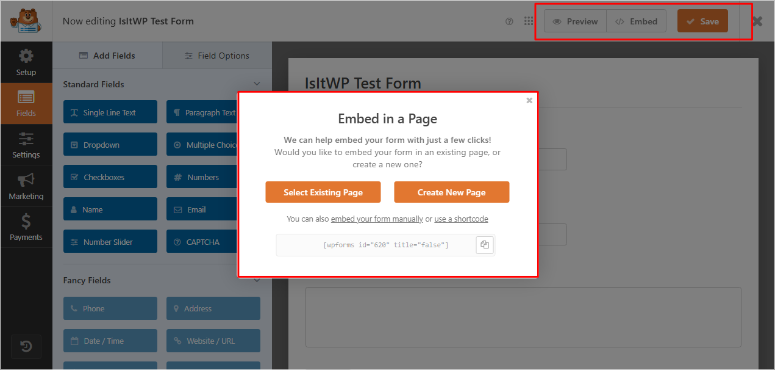
You can add it on a new or existing page with the WPForms Block, create a new page with the form already placed, or use a shortcode to add it on any widget-ready place.
Congratulations! From now on, every submission automatically generates a professional, branded PDF. It emails the right people instantly. No manual work required.
The automation handles everything while you focus on your actual business.
Method 2: Formidable Forms Print to PDF (Quick Alternative)
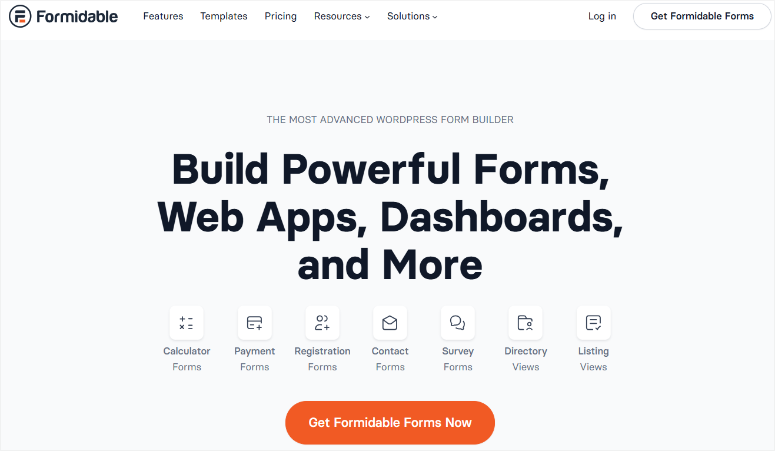
Formidable Forms takes a different approach to PDF generation.
Instead of automated branded templates, it offers a “Print to PDF” feature that’s better for quick one-off exports than automated professional documents.
If you need to manually export form entries for your records, this works fine. But if you want automated branded PDFs sent to customers instantly, WPForms wins by a mile.
Basic Setup
After installing Formidable Forms, navigate to Formidable → Add-Ons in your WordPress dashboard.
Look for the WordPress PDFs plugin in the add-ons list. Click Install next to it.
The PDF generation functionality becomes available immediately. No complex configuration needed for basic exports.
Print to PDF Process
Next, navigate to your form’s Entries page. Find the entry you want to export and click View or Edit below the entry row.
Look in the right sidebar on the entry details page and select the Download as PDF button to download the PDF file to your computer.
The PDF includes all the form data in a simple layout. Clean, functional, but not branded or customized.
That’s it! You can now create PDF files from your form submissions using both WPForms and Formidable Forms.
But what are the key differences between these two form plugins when it comes to handling PDFs?
WPForms vs Formidable Forms for PDFs: Quick Comparison
Here’s how the two plugins stack up specifically for PDF generation:
| Feature | WPForms Pro | Formidable Forms |
|---|---|---|
| Branded Templates | 40+ pre-designed | Custom Views only (requires coding) |
| Setup Time | 15 minutes | 30-45 minutes (basic), hours (custom) |
| Visual Editor | ✅ Live preview | ❌ Code-based |
| Automatic Email | ✅ Built-in attachment | ✅ Basic attachment |
| Logo Upload | ✅ Drag and drop | Requires HTML/CSS |
| Custom Branding | ✅ 40+ color themes | Requires custom Views |
| Best For | Automated branded PDFs | Manual exports, advanced customization |
| Technical Skill | Beginner-friendly | Intermediate to advanced |
| Price | $199.50/year (Pro) | $199.50/year (Business) |
Choose WPForms If:
- You want professional branded PDFs without touching code. The visual template editor lets you customize everything by clicking. Perfect for invoices, quotes, certificates that customers see.
- You need automation. Set it up once, and every form submission generates a PDF automatically. No manual work ever again.
- You value your time. 15 minutes to professional PDFs versus hours coding custom Views in Formidable.
Choose Formidable Forms If:
- You need quick manual exports for admin records. The Print to PDF button works fine for internal documentation.
- You’re comfortable with HTML and CSS. If you can code custom layouts, Formidable’s Views give you pixel-perfect control.
- You already use Formidable for complex form logic. Adding basic PDF export makes sense if you’re committed to the ecosystem.
My honest recommendation? For PDF generation specifically, WPForms beats Formidable Forms in ease of use, speed, and professional results. Formidable Forms excels at other things (advanced calculations, complex conditional logic), but PDFs aren’t its strength.
Read my full WPForms vs Formidable Forms comparison to see how they compare across all form features, not just PDFs.
If anything is unclear, check out the commonly asked questions below.
FAQs: Converting Form Submissions to PDF
Do I need WPForms Pro for PDF generation?
Yes, the PDF Addon requires WPForms Pro or higher. The Lite version doesn’t include PDF functionality at all. You’ll need to upgrade to access the addon, templates, and automatic generation features. The Pro plan starts at $199.50/year and includes the PDF Addon plus other premium features.
Can I edit a PDF after it’s generated?
No, with WPForms, PDFs automatically generate based on form submissions. You can’t edit individual PDFs after creation. If you need changes, update the PDF template in your form settings before new submissions come in. All future PDFs will use the updated template. Existing PDFs remain unchanged.
How many PDF templates can I use per form?
You can create unlimited PDFs per form with WPForms. Some people set up multiple PDF types for one form – one invoice for the customer, one packing slip for shipping, one internal record for accounting. Each PDF can use a different template and branding. Just click “Add New PDF” for each version you need.
Can users download the PDF directly from my website?
Yes, with WPForms, you can use shortcodes on confirmation pages or thank you pages. Place the shortcode where you want the download link to appear. Users click it and get their PDF immediately after form submission. This works great for instant receipts or certificates people want to download right away without checking their email.
Does the PDF include file uploads from the form?
Yes, file upload links appear in the PDF with WPForms. Users won’t see the actual uploaded files embedded in the document, but they’ll get clickable links to access the files. This keeps PDF file sizes manageable while still providing access to uploaded documents, images, or attachments from the form submission.
What if I need more customization than templates offer?
Use WPForms’ Views feature for advanced customization with HTML and CSS. This gives you complete control over PDF layout, styling, and structure. Or switch to Formidable Forms if you need maximum flexibility and you’re comfortable coding custom layouts. Most people find the 40+ WPForms templates handle everything they need, though.
Final Thoughts: Professional WordPress Form PDFs Made Simple
Converting form submissions to PDF doesn’t require copying data into Word documents anymore.
WPForms automates the entire process. All you need to do is pick a template, add your branding, and every submission generates a professional PDF automatically.
As a result, customers receive branded documents instantly, and you save hours every week.
On the other hand, Formidable Forms works for quick manual exports when you need basic PDFs for admin records. But for customer-facing documents that need to look professional? WPForms wins.
The time savings compound fast. What took me 3 hours for 27 invoices now takes zero time. The security and peace of mind matters too.
No more sketchy online converters with client data. And the professional appearance builds trust that generic emails never could.
Legal recognition, automatic record-keeping, instant delivery; all handled by a plugin that costs less than one hour of freelance work.
Related Resources
Now that you can generate professional PDFs from your forms, here are some resources to enhance your form functionality even further:
- How to Make a WPForms + Dropbox Connection – Automatically save your generated PDFs to Dropbox for cloud storage and easy client access. Perfect if you’re managing lots of documents and need organized file storage beyond email attachments.
- How to Create a Registration or Payment Form with PayPal Fields – Combine PDF generation with payment processing to create professional invoice systems. Users pay through the form and receive an instant PDF receipt.
- 12 Best WordPress Calendar Plugins – Add appointments to Google Calendar automatically from form submissions. Great for booking forms that generate PDF confirmations for scheduled services.
- +11 Best WPForms Pro Alternatives – Exploring other form builders? This comprehensive comparison helps you choose the right plugin for your specific needs and budget.
- Contact Form 7 vs WPForms Lite – If you’re deciding between free form builders before upgrading to Pro for PDF functionality, this detailed comparison shows you which foundation works best.
- 7 Best Newsletter Popup Plugins – Capture leads with popups and send them professional PDF lead magnets automatically. Combine form submissions with instant PDF delivery for powerful lead generation.
These articles will help you understand how to use WordPress forms better for your business. Most importantly, they will make it easier for you to handle client data directly in WordPress.
Start with creating PDFs from form submissions today, and use the guides above to evolve as your business grows.

Comments Leave a Reply